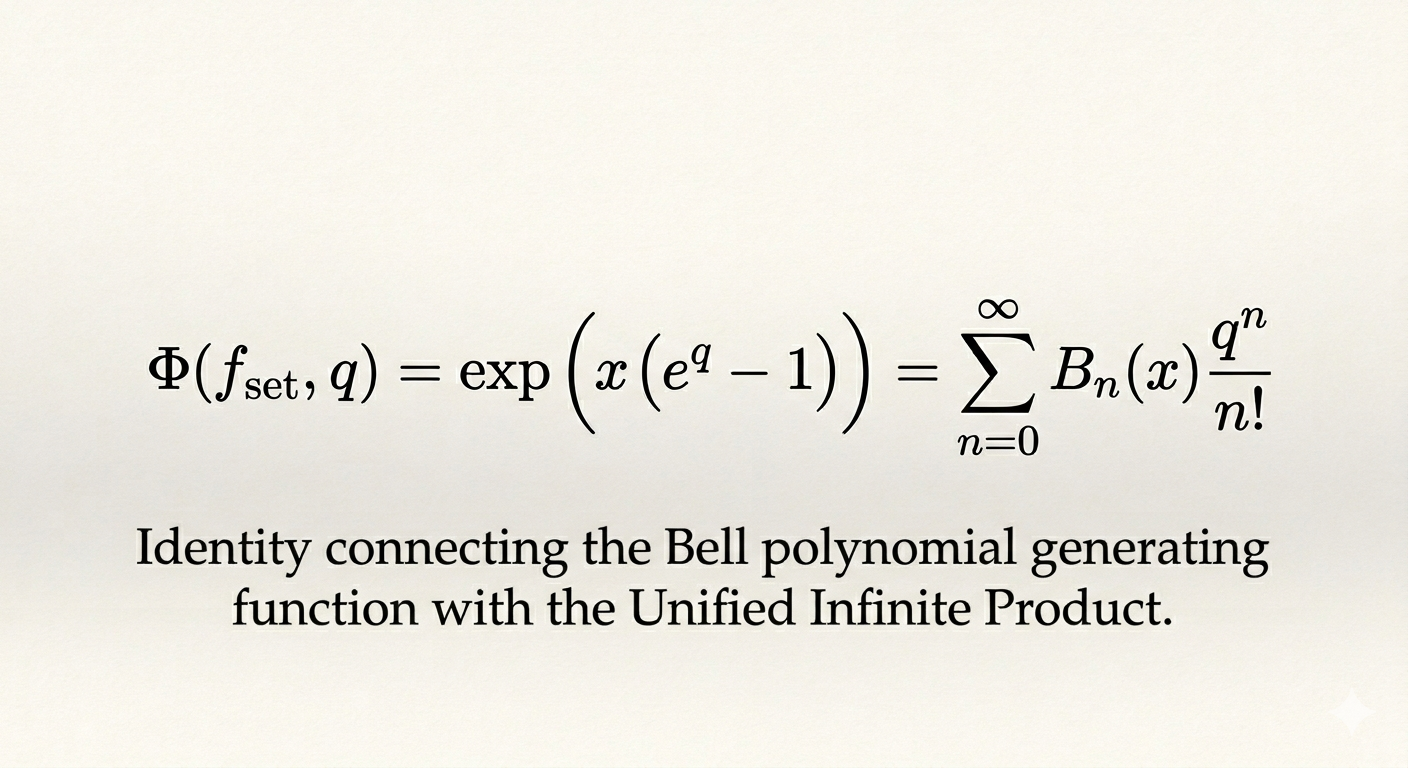
Every math enthusiast has, at some point, been captivated by the sheer beauty of Euler’s Partition Identity. This theorem, stating that “the number of partitions of $n$ into odd parts equals the number of partitions of $n$ into distinct parts,” is elegantly proven using the powerful machinery of infinite products.
But what if this stage of infinite products conceals a “world beyond” that we have yet to explore?
In this PDF paper, we introduce an original algebraic framework termed the “Unified Infinite Product.” Through this lens, we unveil the profound truth that integer partitions (the problem of dividing a number) and Bell polynomials (which govern set partitions, or the problem of grouping distinct elements)—two realms that appear completely unrelated at first glance—are beautifully interconnected behind the scenes of infinite products.
Abstract
In this paper, we introduce the Unified Infinite Product framework, a generalized approach to integer partitions parameterized by a double-indexed weight function $f(k, l)$ that assigns a specific weight when a part of size $k$ is chosen with multiplicity $l$. By treating the partition generating function as a formal power series, we demonstrate that this framework seamlessly unifies classical combinatorial results—ranging from Euler’s partition identities to the emergence of the Stirling numbers of the second kind. Furthermore, we uncover the phenomenon of “functional degeneracy,” wherein distinct local weight rules yield identical global generating functions. To elucidate this symmetry, we establish a rigorous algebraic foundation by proving that the space of normalized weight functions under Cauchy convolution is isomorphic to the infinite direct product of the group of principal units ($\mathcal{F} \cong G^{\mathbb{N}}$). This algebraic perspective fully characterizes the degeneracy via the kernel of the group homomorphism and reveals “perfect flattening” mechanics where complex infinite products elegantly collapse into elementary polynomials.

コメント